Review: Bob Dylan Live
Bob Dylan live in concert on his Rough and Rowdy Ways Tour

Review: Bob Dylan Live
Bob Dylan live in concert on his Rough and Rowdy Ways Tour
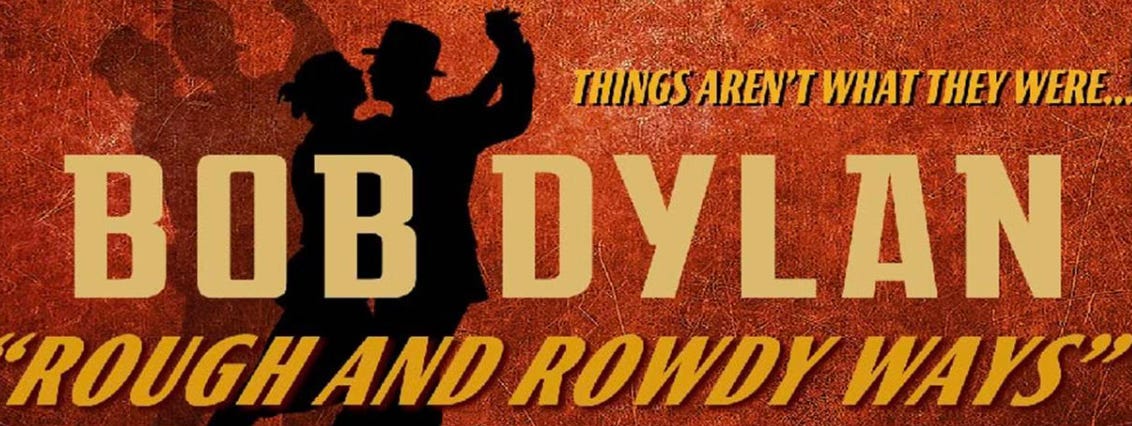
I saw the genius that is Bob Dylan in concert last night.
And I’m still absolutely buzzing now at having seen one of my musical idols play live once again.
Dylan opened with I’ll Be Your Baby Tonight, taken from his 1967 album John Wesley Harding. Covered by everyone from Robert Plant to UB40, Dylan put his inimitable stamp on his own work, with a pared back version full of slow style, if slightly elongated in length.
The octogenarian followed it up with his 1964 effort, It Ain’t Me Babe, from his Another Side of Bob Dylan album - and even if I’ve always preferred Johnny Cash’s version, it was fascinating to watch Dylan and his band, inhabit the dark and barren stage.
Backlit, on a sparse stage, Dylan at his piano looked ephemeral, a spectral presence, while his giant silhouette was the perfect backdrop for a raft of his latest songs.
Naturally the spine of the gig were songs taken from his 2020 album Rough And Rowdy Ways, hence the name of the tour.
Dylan being Dylan, all phones were put away in a sealed bag beforehand, ‘to enhance the experience.’ It worked. Prior to the start, strangers talked to each other, eagerly and in anticipation of the great man’s forthcoming arrival, and during the concert that lasted a wonderfully satisfying one hour and 45 minutes, people concentrated, savoured, and relished the music, without their own fidgety and banal interruptions.
At the Swansea Building Society Arena, a surprisingly impressive 3,500 new auditorium built in this tough but welcoming South Wales city in 2022, as part of a £135 regeneration project along the previously neglected waterfront, Dylan played his most recent album’s opening track, I Contain Multitudes.
His live arrangement made the song jaunty rather than bleakly malevolent, as he confided: “I sing the songs of experience like William Blake/I have no apologies to make.”
Also subverting expectations was his sinister Black Rider, in which you wonder if the narrator is talking with the devil, or at least a dark entity. Yet, once again, Dylan’s idiosyncratic endeavours allowed the sense of irony to emerge, rather than an ominous foreboding. “You’ve seen the great world and you’ve seen the small/You fell into the fire and you’re eating the flame.”
While Crossing the Rubicon was a theatrical romp, rather an allegorical lament, even if Dylan’s true meaning surely relates to America nearing - if not already passing - the point of no return in terms of its political landscape, as he sang: “Three miles north of purgatory - one step from the great beyond…”
As an antidote to the references - oblique and otherwise - to dire current situation in the US, Dylan played To Be Alone With You. A love song taken from his 1969 country album Nashville Skyline. Interestingly, Dylan took 20 years to play the song live, but has since performed it hundreds of times, most recently during this tour. It’s one of his few songs that appears to easy to decipher, as it’s simply about wanting his girl.
…..
However, one of the ways Dylan’s genius shines through is ambiguity of his lyrics that somehow produces a spellbinding universality - so to witness the legend sing his 1965 It’s All Over Now Baby Blue taken from the seminal album Bringing It All Back Home, moved me beyond expectation.
Is the song a paean to finality, a homage to renewal from the depths of despair, an anthem for relationship breakups, or more prosaically, a figurative and literal goodbye to his pre-electric life which changed the world - a farewell to his devoted folk audience, harmonicas and all, some of who never forgave the musical betrayal in the mid 1960s. “You must leave now, take what you need you think will last/But whatever you wish to keep, you better grab it fast.”
With all of the above in mind, whatever your interpretation - which could also have been Dylan bidding adieu to then lover Joan Baez - to witness the 84-year-old Voice of a Generation sing such a legendary song on cold, wet Monday evening in south Wales was heartbreakingly poignant.
Was it also goodbye from Dylan himself?
As the song neared its conclusion, and the troubadour introduced a quick burst of his harmonica, it felt like you were watching an old master.
Towards the end of his rendition of such an important song, as fresh and vibrant and relevant today, as it was 50 years ago, to experience the strains of his trusty ‘Blues Harp’, to see and feel Dylan sing at the climax, “Strike another match/go start anew/And it’s all over now, Baby Blue…” was the equivalent of observing Da Vinci at work, Rembrandt in action, Olivier’s Hamlet, a Cruyff turn, a Pele feint, a Keith Miller cover drive.
Dylan is a poet genius. Poignant and profound. Mysterious and mercurial.
His unorthodoxy allied with elegance, complexity and ambiguity, amid deep mastery, wrapped up in an idiosyncratic flair produced a deep and profound joy in my soul last night, bordering on a moment of spiritual rapture. It was simply fantastic.
For isn’t genius meant to deeply affect you, the catalyst in prompting a significant emotional response far beyond the everyday and humdrum?
That’s what I felt on Monday.
I’ve seen Dylan before, but two years ago, I was more in awe of witnessing a hero of mine in the flesh, than to experience his music on a higher level of appreciation.
Dylan is such a craftsman, that in his book The Philosophy of Modern song, he discusses how, even the addition of a single extra syllable in his writing can diminish a song. It’s that level of perfection that he brings to his work, every single time.
In the up-tempo Goodbye Jimmy Reed - the sixth track from his outstanding Rough And Rowdy Ways album - Dylan also brought addictive rhythms in tribute to the unsung Blues man the Rolling Stones and Elvis appropriated.
Dylan ended with the hauntingly beautiful Chimes of Freedom-style Every Grain of Sand, from one of his lesser-known albums, Shot of Love.
Yet his 1981 song has been lauded by everyone from Bruce Springsteen to Elvis Costello, and covered by plenty from Chrissie Hynde to Nana Mouskouri.
No wonder Emmylou Harris sang the mournful and melancholic strains at the 2003 funeral of Dylan’s lifelong friend, Johnny Cash.
The compassion and heartbreak, vulnerability and redemption evident at such an exquisite composition nearly moved me to tears.
But then, as I get older, and you realise the end is now nearer than the beginning, and as life and its challenges make you wiser but weaker, plenty of sad - and compassionate - things move me to the point of tears these days.
And Dylan’s rendition of such an achingly sublime song - this massively underrated but sublimely elegiac refrain - was enough. “In the bitter dance of loneliness fading into space/In the broken mirror of innocence on each forgotten face…”
Thankfully, I pulled myself together to watch, and consider Dylan - maybe for the last time - as the applause broke loudly at the end of his final song.
I watched spellbound as he stood up from his piano, and sidled to the back of the stage.
Not moving an inch, the immortal Dylan eyed the crowd, stark upright, refusing to bow or acknowledge the acclaim, perhaps deciding whether to sing again, before, to the disappointment of many expecting an encore, shuffling off, to exit, pursued by the hopes of an audience.
I thought at that precise moment, if Dylan didn’t turn up to collect his Nobel Prize in Literature, he’s hardly going to be swayed by calls for a return to the stage on a wet Monday evening in Swansea, no matter how much we desperately wanted him to amid the relentless cheers.
Or, at the very least, return to perhaps recite a line or two of local boy Dylan Thomas’ poetry. After all, depending on which story the singer recited over the last six decades - or which version you actually believed - the singer took his name from the Swansea-born poet, writer and firebrand. Yet even that tale wasn’t enough for the great man to reappear.
But as we all know, Dylan didn’t make his name through encores, and pandering to cheap plaudits.
Absolutely not.
For it’s his stunning life’s work across six decades of words and lyrics, and music and melodies that counts. That’s what matters. A stunning portfolio guaranteeing a legacy that will last as long as music is played.
His catalogue, already loaded with significance through his superb storytelling, and layered with meaning, nuance, refinement, suggestion, subtlety, shade and implication - as much as strength, energy and potency - made his lyrics important to you, the listener.
Beautiful, haunting, evocative lyrics, at times impenetrable as James Joyce, yet always forceful and compelling - whether you understood them or not - which were allied, invariably, with an ambivalence that allowed you to overlay whatever you felt the words meant to you.
Your experiences imbued meaning onto his lyrics, as much as his words sought out relevance in your life.
Melodies, evocative and haunting, that told a million stories - even some you understood, and related to - fed your moments, your people, your experiences, your life.
For, quite simply Dylan made his work personal to you.
An ability - while transcending time - to produce a mesmerising universality which can profoundly move you.
That is what was on show on Monday evening.
That is Dylan’s genius, as much as anything.
No wonder I’m still absolutely buzzing from the experience.
I so enjoyed reading this, Layth - thank you!
Thank you. Dylan has been my constant companion through my life. I can always find something in his work to sit with how I feel. ‘poems in naked wonder’ indeed.